Does your writing sound bland and voiceless? Are you struggling for a precise word to describe a character in the book you are reading? It is your LUCKY day!
Moving Beyond “Mad, Sad, and Glad”
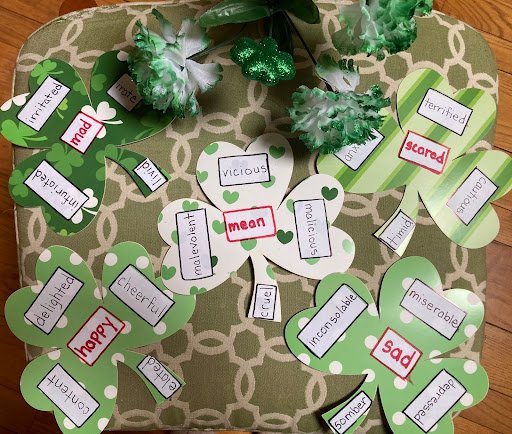
Provide your students with words that go beyond the typical mad, sad and glad. Lift up scared and mean. Give students (or your child) some choices of words that have almost the same meaning. Have them think about the intensity of the feeling to choose just the right word to express their intent.
Understanding Shades of Meaning
While these words can be considered synonyms, they are more about the shades of meaning: the subtle differences in intensity, emotion, or precision between similar words. When you organize words on a gradient, such as moving from weak to strong, cold to freezing, or small to microscopic, your language becomes more precise and more interesting to the reader or listener.
A Shamrock Activity for Exploring Word Meaning
Because St. Patrick’s Day is near, you can collect shades of meaning words on shamrocks. Students can have access to them as they write and talk. They can use them as playing cards in partnerships in a Mystery Word game: “I’m thinking of a word that means scared, but is more like when you are nervous about something.” (anxious)
Other Simple Ways to Visualize Word Intensity
Shades of Meaning can go well beyond shamrocks. Some people use paint strips. Others create a thermometer or speedometer. You can even design it as a volume control. The simplest way is to create a vertical number line (without the numbers - see below)
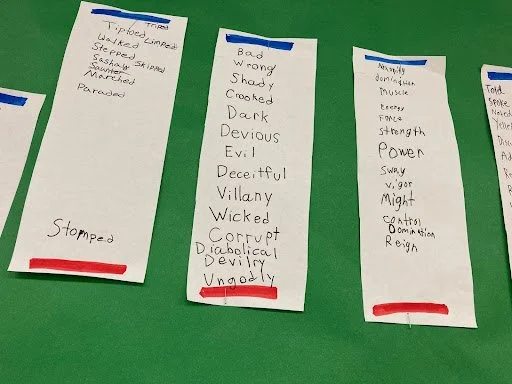
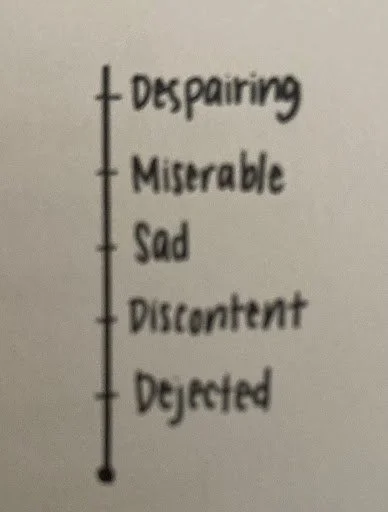
As students begin to notice the subtle differences between words, their writing grows richer and more precise. Teaching shades of meaning helps children see that words are not just labels—they are tools that capture emotion, intensity, and intent. Simple activities like organizing words on shamrocks, paint strips, or number lines can spark this deeper awareness of language.
So this March, help your students get a little lucky with words. When children start noticing how small shifts in language can change meaning, they carry that curiosity about words into everything they read, write, and say—and that is where joyful word learning truly begins.
To learn more about this instructional technique, see Mary Ehrenworth’s book Vocabulary Connections, 2025.