Savvy Suffixes: A Simple Guide to Teaching Morphology with Confidence
As I meet with teachers across the several districts I support as a staff developer, they effortlessly use words like phoneme and grapheme. However, when I begin to mention morphology, there is often a sense of discomfort. And it can be confusing. In fact, last week I was having a conversation with a few expert educators across the country and there was confusion around the difference between a root and a base.
What Is Morphology? Understanding Morphemes
A morpheme is a unit of meaning that may or may not stand alone.
All words have at least one morpheme.
Morphemes add some level of meaning.
The morpheme is the smallest unit of sound that carries meaning in a word. (This is not to be confused with a phoneme which is the smallest unit of sound.)
A morpheme can be an entire word, or just a part.
Morphemes are divided into two groups:
Free Morphemes: a stand-alone word
Bound Morphemes: a word part (like a suffix)
Morphemes can be tricky. You cannot simply tell students to look for letter sequences. They must think of meaning. Consider the words below when teaching the prefix re-...
really reader retie realistic reptile
It is only in the word retie that re- is acting like a prefix!
PHEW!
What Is a Suffix? A Simple Breakdown
Let’s start this morphology series with suffixes. A suffix is a bound morpheme - a meaningful unit that cannot stand alone. It must be attached to other morphemes. This is usually the type of affix that is taught first, usually beginning in Grade One.
Inflectional vs. Derivational Suffixes
There are two types of suffixes: inflectional and derivational. Inflectional suffixes are added to words to show verb tense
(jump +ing) or number (dog+s) or to compare (long-er, long-est). Derivational suffixes are added to words to change their part of speech (act: verb; act-ion: noun)
Inflectional Suffixes are easier. They do not change the part of speech and there are less of them. That is why this type of suffix is often taught in the primary grades.
Derivational Suffixesare more challenging. They do change the part of speech and are more plentiful. Instruction around this type of suffix usually begins in the intermediate grades and is continued to be learned through middle and high school.
Caution: The suffix -er is tricky as it sometimes functions as an inflectional suffix in its comparative form (red, redder, reddest) and sometimes as a derivational suffix when it means “one who”
(teacher, player). The derivational form is more common.
The 10 Most Important Suffixes to Teach First
-s/ -es
-ed
-ing
-ly
-er (one who) (Carroll et al., 1971)
-ion, -tion, -ation, -ition
-able, -ible
-al, -ial
-y
-ness
These ten suffixes (along with the first nine prefixes: coming in Part Two) appear in over 70% of affixed words (Eide, 2012). So it not only makes sense to teach them first, but to also teach them early… beginning in 1st grade.
Spelling Rules That Support Suffix Learning
Along with teaching the meaning of these suffixes, spelling must also be taught. Inflectional suffixes often demand spelling changes:
Adding -s and -es (cats, foxes)
Irregular Plurals: (wolf-wolves) In some words, the vowel shifts when the word is plural (man-men). You also have other words where the singular and plural forms are the same (deer).
Changing y to i (happy-happier)
Doubling the final consonant (clipped). Teach the 1-1-1 Rule:
One syllable, one vowel, one consonant: double the final consonant.
Drop silent e (take-taking)
How to Teach Suffixes Explicitly and Systematically
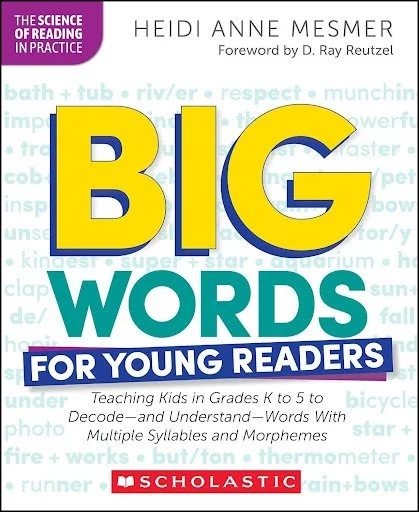
When teaching suffixes, you must always be explicit and systematic. You follow a scope and sequence and your language is direct and clear. I like Heidi Anne Mesmer’s simple routine to introduce a new affix (prefix or suffix):
Name the affix.
Pronounce it.
Define it.
Give an example. (Be sure to use a word your students know and can read.)
Engaging Suffix Activities for the Classroom
1. Word Equations
nod + d + ed = nodded
fry - y + i +es = fries
2. Find the Base, Code the Word
Begin with a fully inflected word and move backwards to identify the
base.
hoping Underline what remains without the suffix.
hope ing Use a caret for a letter that was added. (I used red)
(You can slash any letter that is taken out.)
BASE: hope
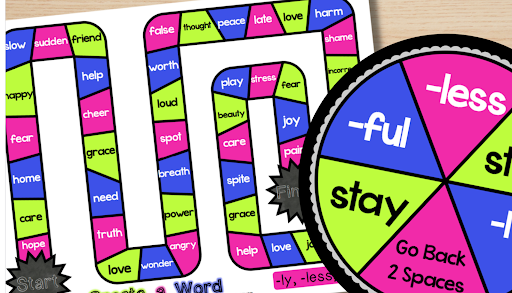
3. Suffix Spinners
(Available on TpT or make your own)
4. Roll & Read
Create a grid of six boxes across and 11 down. Going across the top, add an image of a die (1-6) in each box. Below each die, add words on the suffixes you want to practice. The child rolls the die. They must read a word in the column that matches the number they rolled. If correct, they place a Bingo chip (different color chips for each player) on the word. If wrong, they lose their turn. If the column is already filled, they lose their turn. The person with the most chips on the board wins.
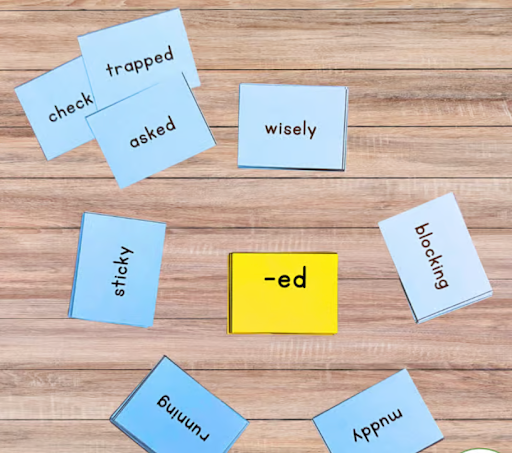
5. Suffix Pick Up
This game needs a deck of suffix cards placed right-side up in the center. A deck of base words with the suffix is placed upside down around the suffix. Children take turns flipping over a base word card. If it matches the suffix in the center, they must read the word and use it in a sentence to keep it. If they can’t do all three things, the card is placed at the bottom of the pile. Once all players have had a turn, the suffix card in the center goes on the bottom to reveal a new suffix. The player with the most cards wins.
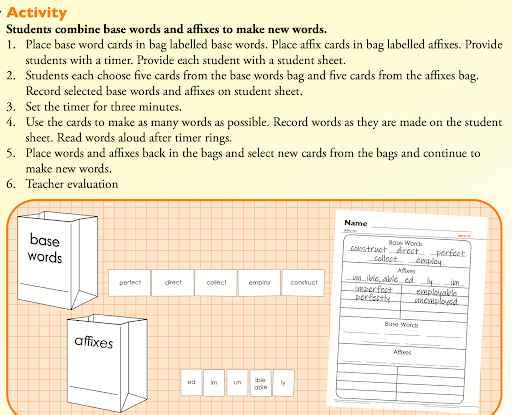
6. Affix Wiz (from fcrr.org)
Bringing JOY to Morphology Instruction
Morphology doesn’t have to feel overwhelming—for you or your students. When suffix instruction is clear, intentional, and rooted in meaning, it becomes a powerful tool for unlocking vocabulary and deepening comprehension. By focusing on high-impact suffixes, explicitly teaching spelling patterns, and incorporating engaging practice, you’re giving students the building blocks they need to confidently make sense of new words. And the best part? This is just the beginning. Stay tuned as we continue building your morphology toolkit—because when students understand how words work, they don’t just read… they thrive.